
In Peru, around the mid-90’s, approximately 200,000 women and about 20,000 men were sterilized. The majority of these people were marginalized and poor with a rich indigenous background, and were frequently tricked or forced to undergo the medical procedure. When the case became public, justice was promised however it has yet to be carried out.
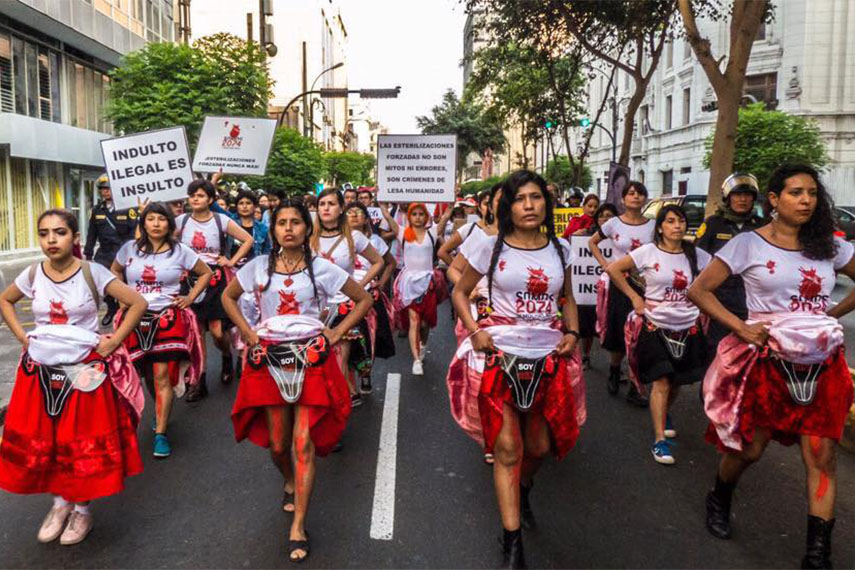
During Alberto Fujimori’s government in Peru (1990-2000), a series of national family planning policies were implemented, leaving 20,693 men and 244,234 women irremediably sterilized. The procedures have since then been condemned as grave human rights violations, especially against indigenous groups in rural areas. As of 2021, around 1,321 women are seeking legal justice against the policy that led to their sterilization.
Fujimori and his government designed the plan to lower the birth rate and reduce poverty, introducing a strategy in which sterilization was offered as a contraceptive method. The public acknowledged the plan as a success, seeing as Fujimori said the procedures were carried out with the patients’ consent and would effectively help decrease poverty. However, over 2,000 women have told rights groups and prosecutors that the sterilization took place without their consent, sometimes being threatened or manipulated by doctors who they claim were receiving state incentives to perform the operation.
In September of last year, the 1,321 women currently seeking justice gathered and embroidered their named onto Peru’s flag in order to spread the word about their case. They dressed in red and white, the colors of the national flag, and held a (socially distanced) demonstration on one of Lima’s beaches, condemning the Peruvian justice system for “turning its back on them.” Women from the Andes have also travelled to the capital to seek justice.
The case was opened almost 19 years ago, yet a court ruling is still pending within Peru’s justice system. Five victims have gone as far as to appeal to international justice, filing a complaint against the Peruvian State before the United Nations Committee on the Elimination of All Forms of Discrimination Against Women (CEDAW) in September of 2020. Peru is now receiving a lawsuit on an international level for carrying out state practices that violated indigenous women’s bodies, a complaint that is demanding reparations for everyone harmed in the implementation of these policies.
Fujimori’s birth control program was aimed towards poor, generally indigenous women, the majority only speaking Quechua. There is testimony from women with over five children who say that they were told by authorities they would be imprisoned or fined if they refused the operation. Around 40 women died from the operations, according to human rights organizations. In 2012, the Inter-American Commission on Human Rights demanded that Peru investigate and punish those involved in the death of Mamerita Mestanza.

Mamerita Mestanza was a 33-year-old woman who was reportedly coerced into the operation that resulted in her untimely death. Mestanza had seven children and lived with her partner in the Encañada district of Peru, working in agriculture. In 1996, health professionals began visiting her regularly to pressure her into undergoing sterilization, reportedly telling her she and her partner would be imprisoned if she refused.
Mestanza agreed in late march of 1998, after receiving ten intimidating visits. She apparently did not receive any medical assistance prior to the procedure nor was informed of the possible consequences and risks.On April 4, 1998, Mestanza passed away from an infection that became fatal due to a lack of medical attention. Her case quickly became a symbol for the predicament of Peru’s indigenous people.
Mestanza’s case was brought before the Inter-American Commission on Human Rights by activists working for reparations and justice. The trial was seen as encouraging of many other victims to come forward with their stories. A team of researchers working on sexual and reproductive rights and how legal means can be used to advance human rights also found the case interesting, one of the researchers being Camila Gianella, a researcher at the Chr. Michelsen Institute.
Following Mestanza’s case before the Inter-American Commission on Human Rights, and thousands of interviews with victims, NGO representatives, Ministry of Health officials, and more, the Peruvian government began to take some responsibility. They agreed to abandon the policy, investigate accusations of forced sterilization, and even settle for a few reparations to some victim’s families.
On Monday, some of the women are expected to go before a judge in hopes that they could finally see justice, according to the lawyers representing them. Their lawyers have said that this hearing could very well become a turning point in the 25-year legal battle, calling it the first step in the possible opening of a criminal investigation. Marina Navarro, director oof Amnesty International Peru has said that the online hearing will mark “the most progress made in the case so far”, noting that it is the first time a judge will publicly consider evidence.
“They were seen by the state as women without a choice and say in what happened to them. They were seen as objects and were dehumanized. The state policy was based on discrimination and racism.”
Rossina Guerrero, programs director at Promsex, a Peruvian group advocating for reproductive rights
Sources:
Foundation, T. (2021, January 8). Haunted by sterilizations, Peruvian women pin hopes on courts. Retrieved January 11, 2021, from https://news.trust.org/item/20210108122157-twyit/
Caso Mamérita Mestanza Chávez. (2020). Retrieved January 11, 2021, from https://www.cejil.org/es/caso-mamerita-mestanza-chavez
Roti Dahl, J. (2019). Changing the public narrative: The case of forced sterilizations in Peru. Retrieved January 11, 2021, from https://www.cmi.no/publications/6827-changing-the-public-narrative-the-case-of-forced-sterilizations-in-peru
M., & Hildenbrand, A. (2020, November 13). The victims of forced sterilizations in Peru continue to demand justice · Global Voices (1149525542 864437943 T. Hasegan, Trans.). Retrieved January 11, 2021, from https://globalvoices.org/2020/11/13/the-victims-of-forced-sterilizations-in-peru-continue-to-demand-justice/
 Help Humans